Google Maps + Paris + teaching instructions = seriously cool. Click on the purple pin to get started.
http://maps.google.co.uk/maps/ms?ie=UTF8&hl=en&msa=0&msid=106744469957319968675.000477900903fa3443371&source=embed&ll=48.813872,2.37751&spn=0.10671,0.298691&z=12
Saturday, February 27, 2010
Tour Mount Everest
http://www.thetech.org/exhibits/online/everest/tour/tour.htm
Apparently the shockwave version is cooler.
Apparently the shockwave version is cooler.
Friday, February 26, 2010
Thursday, February 25, 2010
Lesson Pathways
This used to be a subscription learning service, but now it's free. Apparently made with a lot of input from homeschoolers, it allows you to create a curriculum (or "pathway") for your child on several levels and with different details. This site has great reviews!
http://www.lessonpathways.com/
This allows you to build a custom curriculum for each child, which is REALLY cool, and is apparently very intuitive and user-friendly.
http://www.lessonpathways.com/
This allows you to build a custom curriculum for each child, which is REALLY cool, and is apparently very intuitive and user-friendly.
Drop.io
http://drop.io/howto
This is a great tool if you want to do group lessons online. All the lesson materials can be put in one drop, and then you can invite "collaborators" to join and chat real-time with you about what you have. GREAT virtual homeschool classroom tool!
This is a great tool if you want to do group lessons online. All the lesson materials can be put in one drop, and then you can invite "collaborators" to join and chat real-time with you about what you have. GREAT virtual homeschool classroom tool!
Plagiarism--Understanding it and avoiding it.
http://www.pbs.org/idealab/2010/02/dont-blame-the-tools----people-plagiarize-copy049.html
This is just an article, but it is one of the most clear explanations of what plagiarism is and how to avoid it that I've ever seen.
This is just an article, but it is one of the most clear explanations of what plagiarism is and how to avoid it that I've ever seen.
Make your own musical instruments
http://familyfun.go.com/playtime/making-music-fun-701940/3/
http://www.home.earthlink.net/~graypoodles/index.html
http://www.familycorner.com/family/kids/crafts/9_musical_instruments.shtml
http://www.mudcat.org/kids/
http://familycrafts.about.com/od/musicalcrafts/Musical_Craft_Projects.htm
http://www.nancymusic.com/PRINThomemade.htm
http://www.home.earthlink.net/~graypoodles/index.html
http://www.familycorner.com/family/kids/crafts/9_musical_instruments.shtml
http://www.mudcat.org/kids/
http://familycrafts.about.com/od/musicalcrafts/Musical_Craft_Projects.htm
http://www.nancymusic.com/PRINThomemade.htm
Intro to linear equations
Press next to skip the series preview and get to the math.
http://dep.disney.go.com/solvingforx.html
http://dep.disney.go.com/solvingforx.html
Wednesday, February 24, 2010
Lectures from Nobel Scientists
http://honeywellscience.com/
On video, no less. They call themselves an "Interactive Studio", but there are few, if any, interactives on this site. Mostly video.
On video, no less. They call themselves an "Interactive Studio", but there are few, if any, interactives on this site. Mostly video.
Tuesday, February 23, 2010
Radiology Lab 1: learn to read an x-ray and ct scan.
At first glance this doesn't look cool. But it is.
http://mycourses.med.harvard.edu/collection_display.asp?task=framer&tn=y&lookupGUID=Name{7CAFC8D7-072C-4696-9552-2ECABC640165}
http://mycourses.med.harvard.edu/collection_display.asp?task=framer&tn=y&lookupGUID=Name{F39070FF-FF72-4F0A-9772-81DDD5406B24}
http://mycourses.med.harvard.edu/collection_display.asp?task=framer&tn=y&lookupGUID=Name{39F664AD-CC7E-4DDE-8D7D-BED8DC4727C5}
http://mycourses.med.harvard.edu/collection_display.asp?task=framer&tn=y&lookupGUID=Name{02E31DD7-F2E2-420B-845B-F6EE4D2D25E5}
http://mycourses.med.harvard.edu/collection_display.asp?task=framer&tn=y&lookupGUID=Name{7CAFC8D7-072C-4696-9552-2ECABC640165}
http://mycourses.med.harvard.edu/collection_display.asp?task=framer&tn=y&lookupGUID=Name{F39070FF-FF72-4F0A-9772-81DDD5406B24}
http://mycourses.med.harvard.edu/collection_display.asp?task=framer&tn=y&lookupGUID=Name{39F664AD-CC7E-4DDE-8D7D-BED8DC4727C5}
http://mycourses.med.harvard.edu/collection_display.asp?task=framer&tn=y&lookupGUID=Name{02E31DD7-F2E2-420B-845B-F6EE4D2D25E5}
Monday, February 22, 2010
Educational Show Alert: Big Green Rabbit
I had heard music from this show before but never watched it. It is fun, music- and dance-oriented, and full of educational science content. You can watch the show, learn songs and dances, and play games here:
http://www.biggreenrabbit.com/
and access parent and teacher materials here:
http://biggreenparents.com/
Episode summaries are here: http://biggreenparents.com/?page_id=434
What you can't find on their site, you might be able to find on YouTube.com.
If you love the show, go back often to the parent site and download episodes and songs free.
http://www.biggreenrabbit.com/
and access parent and teacher materials here:
http://biggreenparents.com/
Episode summaries are here: http://biggreenparents.com/?page_id=434
What you can't find on their site, you might be able to find on YouTube.com.
If you love the show, go back often to the parent site and download episodes and songs free.
New Feature on the Sidebar
I have puzzled about what to do about educational TV shows on this blog. I can't possibly index every single episode, and most of them cover many topics. These are, however, some of the best friends of homeschoolers (right up there with museums and libraries). The kids get to learn from the show, and then most of the educational TV shows have websites with follow up activities, games, and other educational content. HUGELY valuable, impossible for me to add to the library in any meaningful way.
My solution:
When I run across an educational show, I will put up a post about it that won't appear in the index, but I will also put a link list on the sidebar of the blog listing educational shows (and their websites). That way, if you are creating a lesson on a topic, you can search out materials yourself, just like you can with the Repositories/Libraries list.
So if you don't often visit the blog itself, keep in mind that there are resources available there that might be of help to you when you are designing educational experiences for your kids.
My solution:
When I am designing specific lessons (like I am for Astronomy and Ancient Egypt right now), I will incorporate appropriate episodes from TV shows and podcasts.
When I run across an educational show, I will put up a post about it that won't appear in the index, but I will also put a link list on the sidebar of the blog listing educational shows (and their websites). That way, if you are creating a lesson on a topic, you can search out materials yourself, just like you can with the Repositories/Libraries list.
So if you don't often visit the blog itself, keep in mind that there are resources available there that might be of help to you when you are designing educational experiences for your kids.
Typing Tutor Online
I like this one better than most. And it doesn't involve blood spurting from ninjas.
http://www.typingweb.com/tutor/
http://www.typingweb.com/tutor/
Many ways to learn those multiplication tables
http://www.multiplication.com/learnfacts.htm
We especially love the interactive games: http://www.multiplication.com/interactive_games.htm
We especially love the interactive games: http://www.multiplication.com/interactive_games.htm
Sunday, February 21, 2010
Mrs. Jones Sings
Music Resources and Language Arts Songs here:
http://www.mrsjonesroom.com/songs/alphlist.html
Links to songs from other subjects here: http://www.mrsjonesroom.com/songs/alphlist.html#other
and here: http://www.mrsjonesroom.com/themes/alphlist.html
http://www.mrsjonesroom.com/songs/alphlist.html
Links to songs from other subjects here: http://www.mrsjonesroom.com/songs/alphlist.html#other
and here: http://www.mrsjonesroom.com/themes/alphlist.html
New Feature on the Sidebar
Learning Lynx is not (by far!) the only site that collects educational links for people. There are many many other "web portals" and "repositories" out there.
As a new feature on the blog, I will have links to other repositories and Web Portals on the side bar. So if you never come visit the blog itself, pop in sometime to see where else you can get info when you need it.
As a new feature on the blog, I will have links to other repositories and Web Portals on the side bar. So if you never come visit the blog itself, pop in sometime to see where else you can get info when you need it.
AMSER Geography Links
http://www.amser.org/index.php?P=BrowseResources&ParentId=607014
http://www.amser.org/index.php?P=BrowseResources&ParentId=607016
http://www.amser.org/index.php?P=BrowseResources&ParentId=601659
http://www.amser.org/index.php?P=BrowseResources&ParentId=615027
http://www.amser.org/index.php?P=BrowseResources&ParentId=613828
http://www.amser.org/index.php?P=BrowseResources&ParentId=609315
http://www.amser.org/index.php?P=BrowseResources&ParentId=607016
http://www.amser.org/index.php?P=BrowseResources&ParentId=601659
http://www.amser.org/index.php?P=BrowseResources&ParentId=615027
http://www.amser.org/index.php?P=BrowseResources&ParentId=613828
http://www.amser.org/index.php?P=BrowseResources&ParentId=609315
Physiology and Medical Science Links from AMSER
AMSER Religion Links
http://www.amser.org/index.php?P=BrowseResources&ParentId=879862
http://www.amser.org/index.php?P=BrowseResources&ParentId=890762
http://www.amser.org/index.php?P=BrowseResources&ParentId=896480
Some of the links in these sections are not really about religion but the cataloger apparently didn't know what to do with them. For example, the "Journal for the Philosophy of Chemistry" is here. ?
http://www.amser.org/index.php?P=BrowseResources&ParentId=890762
http://www.amser.org/index.php?P=BrowseResources&ParentId=896480
Some of the links in these sections are not really about religion but the cataloger apparently didn't know what to do with them. For example, the "Journal for the Philosophy of Chemistry" is here. ?
Food Atlas
Sometimes, there are maps of more than just cities and physical features of a particular place.
http://maps.ers.usda.gov/FoodAtlas/
http://maps.ers.usda.gov/FoodAtlas/
Saturday, February 20, 2010
LEGO Chemistry
http://www.mindandhandalliance.org/documents/EdgertonLEGOChemteachersguide_1-18-10.pdf
http://www.mindandhandalliance.org/documents/lego-chemistry_student_pages_1-18-10_color.pdf
http://www.mindandhandalliance.org/documents/lego-chemistry_student_pages_1-18-10_black-white.pdf
http://www.mindandhandalliance.org/documents/smaller_lego-chemistry_student-pages_answer-key_1-19-10.pdf
http://www.mindandhandalliance.org/documents/LEGO_Atom_molecules_layout_mat_and_key.pdf
http://www.mindandhandalliance.org/documents/LEGO_chem_reactants_products_12-18-09.pdf
http://www.mindandhandalliance.org/documents/lego-chemistry_student_pages_1-18-10_color.pdf
http://www.mindandhandalliance.org/documents/lego-chemistry_student_pages_1-18-10_black-white.pdf
http://www.mindandhandalliance.org/documents/smaller_lego-chemistry_student-pages_answer-key_1-19-10.pdf
http://www.mindandhandalliance.org/documents/LEGO_Atom_molecules_layout_mat_and_key.pdf
http://www.mindandhandalliance.org/documents/LEGO_chem_reactants_products_12-18-09.pdf
Open Courseware
Colleges all over the world are now putting full courses online for anyone to use. This can be a boon to homeschoolers since college courses are really not that much harder than 5th grade courses--they're just a little more detailed. If you work through them a little slower than an adult would, the materials are often still useful--especially for gifted kids. This is also a good solution for the problem of "early college or not" for homeschooling parents of the profoundly gifted.
Unfortunately, there isn't a central portal that connects you to these courses by subject rather than by institution. So I'm going to build one. It will take a while, but you will find it here:
http://docs.google.com/View?id=ddssdqrh_118g4cdkzhb
I am not ambitious enough to index by individual courses (MIT alone offers 1900), but I will connect you to the subjects, and then you'll have to sort through the individual courses at each institution on your own!
Unfortunately, there isn't a central portal that connects you to these courses by subject rather than by institution. So I'm going to build one. It will take a while, but you will find it here:
http://docs.google.com/View?id=ddssdqrh_118g4cdkzhb
I am not ambitious enough to index by individual courses (MIT alone offers 1900), but I will connect you to the subjects, and then you'll have to sort through the individual courses at each institution on your own!
Making Movies: Script to Screen
At first glance, this is an intro to an offline exhibit, but there is actually a lot of online content you can explore. Scroll down. It's slightly to the right under the words "Script to Screen"
http://www.hrc.utexas.edu/exhibitions/2010/movies/
http://www.hrc.utexas.edu/exhibitions/2010/movies/
Folklife Unit
Focuses on Iowa, but a good intro to folklife as a discipline in general:
http://www.uni.edu/iowaonline/folklife_v2/
http://www.uni.edu/iowaonline/folklife_v2/
Country Dogs Explore ART
http://countrydogs.sfmoma.org/
You can watch stories about the art, exploring famous paintings, or use their art exploration tools to make your own art based on the famous works. REALLY fun.
You can watch stories about the art, exploring famous paintings, or use their art exploration tools to make your own art based on the famous works. REALLY fun.
Language Links--for learning and enjoying non-English languages
http://learninglanguages.net/
This includes such diverse things as lyrics to French songs and using adjectives in Japanese.
All things learning language related. Join free.
This includes such diverse things as lyrics to French songs and using adjectives in Japanese.
All things learning language related. Join free.
Scout Report for Physical Sciences
http://scout.wisc.edu/Reports/NSDL/archive.php#PhysSci
Collections of links compiled and annotated by librarians.
Collections of links compiled and annotated by librarians.
National Science Digital Library Life Science Scout Reports
These are collections of links related to Life Sciences that were collected by librarians. Lots of cool stuff out there!
http://scout.wisc.edu/Reports/NSDL/archive.php#LifeSci
http://scout.wisc.edu/Reports/NSDL/archive.php#LifeSci
Center for Creative Photography
Collection of Ansel Adams and other influential photographers.
http://www.ir.uair.arizona.edu/ccp/browse-collections
http://www.ir.uair.arizona.edu/ccp/browse-collections
Friday, February 19, 2010
The Secrets of Tomb 10A
Now that you know a little about Archaeology, check out this site for how people use archaeology in Egypt to learn about ancient Egyptians.
First this: http://www.mfa.org/tomb/kids.html
http://www.mfa.org/tomb/index.html
First this: http://www.mfa.org/tomb/kids.html
http://www.mfa.org/tomb/index.html
Bram Stoker's Dracula as a blog--very cool
I love Stoker's original Dracula. Here it is in a novel format--as a blog (instead of a novel!). Start back at the earliest date to get it all in order.
http://dracula-feed.blogspot.com/
http://dracula-feed.blogspot.com/
History of Business/Businesses
Annual Reports from 1850 online. Sounds dull, but it's kinda cool to look at, say, Thomas Edison's business reports (especially since they include pictures of his properties, etc).
http://www.columbia.edu/cu/lweb/indiv/business/CorpReports.html
http://www.library.hbs.edu/hc/lehman/
http://www.columbia.edu/cu/lweb/indiv/business/CorpReports.html
http://www.library.hbs.edu/hc/lehman/
Virtual Field Trips all over
http://www.meetmeatthecorner.org/
This has TONS of virtual field trips and space to submit your own. Making a virtual field trip for other kids would be a GREAT activity for a homeschooling family.
This has TONS of virtual field trips and space to submit your own. Making a virtual field trip for other kids would be a GREAT activity for a homeschooling family.
Thursday, February 18, 2010
Local (for us) plants and animals info
http://www.bouldercolorado.gov/index.php?option=com_content&view=article&id=2829&Itemid=1016
Click the links on the left side for more info.
Click the links on the left side for more info.
Tumble Books--animated online ebooks for kids
REALLY cool and fun. Read yourself or they'll read to you. It's like the modern version of those book-and-record combos we had when we were kids (you know, "When you hear tinkerbell, turn the page....")
http://www.tumblebooks.com/library/asp/home_tumblebooks.asp
If that gets you to a "free trial" page, click this link: http://www.ci.longmont.co.us/library/childrens/tumblebooks.htm
and then on the Tumblebooks link on the first line.
http://www.tumblebooks.com/library/asp/home_tumblebooks.asp
If that gets you to a "free trial" page, click this link: http://www.ci.longmont.co.us/library/childrens/tumblebooks.htm
and then on the Tumblebooks link on the first line.
1900 Free Courses (and Competitions) From MIT in all subjects.
This is an awesome resource, especially for families of gifted kids.
http://ocw.mit.edu/OcwWeb/web/courses/courses/index.htm
If the whole list is too daunting, try this one:
Specially Selected Portal for High Schoolers (including 3 AP courses): http://ocw.mit.edu/OcwWeb/hs/home/home/index.htm
http://ocw.mit.edu/OcwWeb/hs/hscourses/hscourses/index.htm
(includes guitar building and excitatory topics in physics)
Competitions: http://ocw.mit.edu/OcwWeb/hs/competitions/competitions/index.htm
Additional resources not linked to a specific course:
http://ocw.mit.edu/OcwWeb/web/resources/supplemental/index.htm
MIT Background info (to help you understand course organizations): http://ocw.mit.edu/OcwWeb/web/resources/curriculum/index.htm
AND even more courses in the Archive: http://ocw.mit.edu/OcwWeb/web/courses/archived/index.htm
http://ocw.mit.edu/OcwWeb/web/courses/courses/index.htm
If the whole list is too daunting, try this one:
Specially Selected Portal for High Schoolers (including 3 AP courses): http://ocw.mit.edu/OcwWeb/hs/home/home/index.htm
http://ocw.mit.edu/OcwWeb/hs/hscourses/hscourses/index.htm
(includes guitar building and excitatory topics in physics)
Competitions: http://ocw.mit.edu/OcwWeb/hs/competitions/competitions/index.htm
Additional resources not linked to a specific course:
http://ocw.mit.edu/OcwWeb/web/resources/supplemental/index.htm
MIT Background info (to help you understand course organizations): http://ocw.mit.edu/OcwWeb/web/resources/curriculum/index.htm
AND even more courses in the Archive: http://ocw.mit.edu/OcwWeb/web/courses/archived/index.htm
Create your own online courses for your kids
Online Science Courses
http://onlinecourses.merlot.org/Sciences.htm
From intro to chemistry and biology all the way to astrophysics and superconductivity.
Take your pick.
From intro to chemistry and biology all the way to astrophysics and superconductivity.
Take your pick.
Calculus Course Materials
You probably need a book, but this site is not book-specific (it appears to work with any text):
http://www.merlot.org/merlot/viewPortfolio.htm?id=408316
http://www.merlot.org/merlot/viewPortfolio.htm?id=408316
Math for Liberal Arts Majors
Awesome interactives and games, as well as resources, linked to this course:
http://www.merlot.org/merlot/viewPortfolio.htm?id=408508
http://www.merlot.org/merlot/viewPortfolio.htm?id=408508
Complete US History through 1877 Course
Includes links to interactives and a 6-lesson "historian's toolbox" unit in addition to the 16-module course:
http://www.merlot.org/merlot/viewPortfolio.htm?id=408522
http://www.merlot.org/merlot/viewPortfolio.htm?id=408522
Biology Materials collected by Merlot
REALLY Great stuff here:
http://biology.merlot.org/materials.html
Choose which kind of material you want (like animations or simulations), and it will take you to a list of links for those. Amazing links they are, too!
More great stuff is at the parent site, here: http://biology.merlot.org/
http://biology.merlot.org/materials.html
Choose which kind of material you want (like animations or simulations), and it will take you to a list of links for those. Amazing links they are, too!
More great stuff is at the parent site, here: http://biology.merlot.org/
Mathematics of Juggling Lesson from AMSER
This includes some links to great interactives and math sites:
http://www.amser.org/ASRM-200912.html
http://www.amser.org/ASRM-200912.html
Wednesday, February 17, 2010
Merlot: Great Resource
I will be exploring this one more, but I thought I'd post the link so you can explore it, too:
http://www.merlot.org/merlot/materials.htm;jsessionid=8296fb4b30d69323d564c56f4f14b44eb29385bde30a.e34Oa30TaN4Ke34Kah8Pb3mSaxf0
http://www.merlot.org/merlot/materials.htm;jsessionid=8296fb4b30d69323d564c56f4f14b44eb29385bde30a.e34Oa30TaN4Ke34Kah8Pb3mSaxf0
AMSER Science Reader Monthly
This is an AWESOME resource. Each month, they produce a "science reader" that links to a publicly available article and summarizes it. Then there are listed six or so links that are intended to help with an educational exploration of the concepts in the article.
These are especially great for students because it is all applied science and math, which are often easier for students to grasp and relate to than theoretical science and math (which always come with the "Who cares?" burden).
http://www.amser.org/AMSER--ScienceReader.php
Depending on the age of the student, this could be one to 7 days worth of instruction each month.
VERY cool and worthwhile.
These are especially great for students because it is all applied science and math, which are often easier for students to grasp and relate to than theoretical science and math (which always come with the "Who cares?" burden).
http://www.amser.org/AMSER--ScienceReader.php
Depending on the age of the student, this could be one to 7 days worth of instruction each month.
VERY cool and worthwhile.
Planetarium movies
Projected onto a dome (like the inside of a dome tent ceiling?), these movies give you a planetarium experience.
If anyone experiments with how to use these to make a planetarium at home, let me know how it works out. I'd love to post instructions here.
http://hubblesource.stsci.edu/sources/video/dome/
If anyone experiments with how to use these to make a planetarium at home, let me know how it works out. I'd love to post instructions here.
http://hubblesource.stsci.edu/sources/video/dome/
The History Time Machine Interactive
This is pretty cool. Can't wait for it to get out of Preview and into full functionality.
http://www.digitalhistory.uh.edu/timemachine/beginX.html
http://www.digitalhistory.uh.edu/timemachine/beginX.html
Tuesday, February 16, 2010
Monday, February 15, 2010
Valentines Day Resources
http://www.universalpreschool.com/how-to/valentines_day.asp
http://www.googolpower.com/content/free-learning-resources/seasonal-math/valentines-day
http://scienceprojectideasforkids.com/science-topic-index/a-science/valentines/?preview=true&preview_id=15796
http://lesson-plans-materials.suite101.com/article.cfm/valentine_letter_writing
http://www.withlovefromloveland.com/loveland_remail.shtml
http://www.history.com/content/valentine
http://www.googolpower.com/content/free-learning-resources/seasonal-math/valentines-day
http://scienceprojectideasforkids.com/science-topic-index/a-science/valentines/?preview=true&preview_id=15796
http://lesson-plans-materials.suite101.com/article.cfm/valentine_letter_writing
http://www.withlovefromloveland.com/loveland_remail.shtml
http://www.history.com/content/valentine
Great Backyard Bird Count
Missed it for this year, but there is great stuff here, including some games, and lots of pictures of birds: http://www.birdsource.org/gbbc/
Sunday, February 14, 2010
Free Online AP Biology course materials
http://www.ignitethefire.com/placement.html
There are other courses linked to here, but the links were broken when I last checked.
There are other courses linked to here, but the links were broken when I last checked.
Saturday, February 13, 2010
Egyptian Archaeology
Photos of exploration of ancient egypt:
http://www.ees.ac.uk/archive/index.html
More about exploring Egypt specifically: http://www.digitalegypt.ucl.ac.uk/themes/record.html
http://www.fas.harvard.edu/~semitic/hsm/GizaHomePage.htm
Now, once they dig stuff up, how do they know what it was for? Sometimes they don't:
http://www.petrie.ucl.ac.uk/search/virtual_exhibitions/exhib.php?username=stephen
More about exploring Egypt specifically: http://www.digitalegypt.ucl.ac.uk/themes/record.html
http://www.fas.harvard.edu/~semitic/hsm/GizaHomePage.htm
Now, once they dig stuff up, how do they know what it was for? Sometimes they don't:
http://www.petrie.ucl.ac.uk/search/virtual_exhibitions/exhib.php?username=stephen
Friday, February 12, 2010
Thursday, February 11, 2010
Astronomy: The Spitzer Space Telescope
http://spitzer.caltech.edu/
http://spitzer.caltech.edu/video-audio/99-ask2003-001-Why-Is-Spitzer-Painted-Black-?autoplay=true&limit=100
Be sure to check out all the awesome video clips under "video and audio".
http://spitzer.caltech.edu/video-audio/99-ask2003-001-Why-Is-Spitzer-Painted-Black-?autoplay=true&limit=100
Be sure to check out all the awesome video clips under "video and audio".
Astronomy: Hubble and Spitzer Work Together
Necessary Background Info
Before we can really understand why the Hubble Space Telescope would ever need (or want) to work with other telescopes, we have to understand how light works. Go to Amazing Space and do this activity:
http://amazing-space.stsci.edu/resources/explorations/light/CatchWaves_activation-frames.html
The Star Spectrum
Now that you've finished that, along the bottom of this image are pictures of the same galaxy taken by different telescopes that take pictures of different wavelengths of light.
ttp://www.sciencenews.org/view/download/id/47748/name/WIDE-SPECTRUM_PORTRAIT
Talk about the different pictures. Are they all the same? Why do you think they are different?
Each picture was taken of a different part of the light spectrum coming from the stars. Each one gives scientists different kinds of information.
The Hubble Space Telescope: How doe it work?
Now, to look specifically at the Hubble Space Telescope: It doesn't work like a regular camera just taking a snapshot of the sky. That doesn't give scientists enough information. Instead, it takes multiple pictures and scientists combine them to get the most information out of them they can. Choose one of the following sites to learn more about this (you can look at both, but they cross over):
http://www.pbs.org/wgbh/nova/sciencenow/0303/01-howi-flash.html --shows the whole process, written by a scientist who has created Hubble images.
http://hubblesite.org/gallery/behind_the_pictures/ --shows how the images are made focusing on just the shape and then on just the colors.
Different pictures--different information--same stars
Now that you know how the images are made, here is a site that compares the Hubble image of a galaxy to the image taken by the Spitzer Space Telescope. Watch the movie--notice how it "morphs" the Hubble image to the Spizter image? They are clearly the same place, but the pictures (and the information scientists can get out of them) are different.
http://spitzer.caltech.edu/video-audio/51-ssc2005-11v1-A-More-Spectacular-Sombrero
What is different between the Hubble and Spitzer images of the same thing? Why are they different?
Maximizing the Possibilities
To get the most information possible, the scientists sometimes combine the images from different telescopes:
Hubble + Spitzer=
and
http://antwrp.gsfc.nasa.gov/apod/ap090107.html
Hubble+Herschel= http://news.bbc.co.uk/2/hi/8127798.stm
Hubble + Chandra= http://www.universetoday.com/wp-content/uploads/2010/01/14.jpg
Hubble + Spizter+ Chandra= http://www.sciencenews.org/view/generic/id/49423/title/The_Milky_Way,_aglow_with_activity_
And now we'll go back to one of the pictures we looked at before.
Engagement Activity
Before we can really understand why the Hubble Space Telescope would ever need (or want) to work with other telescopes, we have to understand how light works. Go to Amazing Space and do this activity:
http://amazing-space.stsci.edu/resources/explorations/light/CatchWaves_activation-frames.html
The Star Spectrum
Now that you've finished that, along the bottom of this image are pictures of the same galaxy taken by different telescopes that take pictures of different wavelengths of light.
ttp://www.sciencenews.org/view/download/id/47748/name/WIDE-SPECTRUM_PORTRAIT
Talk about the different pictures. Are they all the same? Why do you think they are different?
Each picture was taken of a different part of the light spectrum coming from the stars. Each one gives scientists different kinds of information.
The Hubble Space Telescope: How doe it work?
Now, to look specifically at the Hubble Space Telescope: It doesn't work like a regular camera just taking a snapshot of the sky. That doesn't give scientists enough information. Instead, it takes multiple pictures and scientists combine them to get the most information out of them they can. Choose one of the following sites to learn more about this (you can look at both, but they cross over):
http://www.pbs.org/wgbh/nova/sciencenow/0303/01-howi-flash.html --shows the whole process, written by a scientist who has created Hubble images.
http://hubblesite.org/gallery/behind_the_pictures/ --shows how the images are made focusing on just the shape and then on just the colors.
Different pictures--different information--same stars
Now that you know how the images are made, here is a site that compares the Hubble image of a galaxy to the image taken by the Spitzer Space Telescope. Watch the movie--notice how it "morphs" the Hubble image to the Spizter image? They are clearly the same place, but the pictures (and the information scientists can get out of them) are different.
http://spitzer.caltech.edu/video-audio/51-ssc2005-11v1-A-More-Spectacular-Sombrero
What is different between the Hubble and Spitzer images of the same thing? Why are they different?
Maximizing the Possibilities
To get the most information possible, the scientists sometimes combine the images from different telescopes:
Hubble + Spitzer=
and
http://antwrp.gsfc.nasa.gov/apod/ap090107.html
Hubble+Herschel= http://news.bbc.co.uk/2/hi/8127798.stm
Hubble + Chandra= http://www.universetoday.com/wp-content/uploads/2010/01/14.jpg
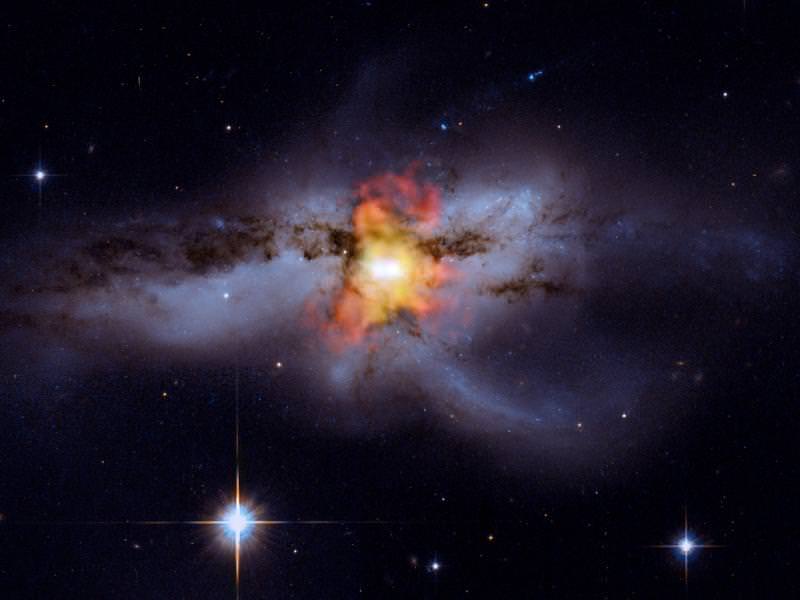
Hubble + Spizter+ Chandra= http://www.sciencenews.org/view/generic/id/49423/title/The_Milky_Way,_aglow_with_activity_
And now we'll go back to one of the pictures we looked at before.
The top pictures there is actually a combination of all the little pictures. It is Chandra+ Galen+ 2Mass+ Spitzer+ IRAS+ VLA! (you can read the article this came from and learn more about all of these here: http://sciencenews.org/view/feature/id/47686/title/Windows_on_the_Universe)
Engagement Activity
Now, finally, it turns out that YOU can make space images like Hubble's at home! Click this link to learn how.
http://hubblesource.stsci.edu/services/articles/2005-02-10/
Build your own space mission
So what are some of the tools we use in space?
Look at this coloring page: http://funschool.kaboose.com/images/printables/space_coloring2.pdf
Now go play this game:
http://jpl.nasa.gov/education/BuildMissionGame.cfm
Notice in the game that it mentions how long it takes messages to travel to earth?
It takes even longer for messages to travel from the stars. Watch this:
http://spitzer.caltech.edu/video-audio/659-irastroSD017-Robot-Astronomy-Talk-Show-Back-in-Time
Look at this coloring page: http://funschool.kaboose.com/images/printables/space_coloring2.pdf
Now go play this game:
http://jpl.nasa.gov/education/BuildMissionGame.cfm
Notice in the game that it mentions how long it takes messages to travel to earth?
It takes even longer for messages to travel from the stars. Watch this:
http://spitzer.caltech.edu/video-audio/659-irastroSD017-Robot-Astronomy-Talk-Show-Back-in-Time
Wednesday, February 10, 2010
Pirate Archaeology
Lesson plan with cool links: http://www.nationalgeographic.com/xpeditions/lessons/17/g68/archaeology.html
Online National Park Fun
Scroll to page 2 for the online stuff:
http://school.discoveryeducation.com/parents/pdf/Visit%20National%20Parks.pdf
http://school.discoveryeducation.com/parents/pdf/Visit%20National%20Parks.pdf
Archaeology Interactives and Games
http://www.saa.org/publicftp/PUBLIC/links/websites_kids.html
http://www.saa.org/publicftp/PUBLIC/links/PAWebSitesInteractive.html
http://www.saa.org/publicftp/PUBLIC/links/archaeologywebsites_classroomuse.html
http://www.saa.org/publicftp/PUBLIC/links/archaeologywebsites_virtual.html
http://www.sha.org/EHA/secondary/interactive.cfm
http://www.sha.org/EHA/secondary/forfun.cfm --GAMES!
http://www.nps.gov/history/aad/public/kids.htm
http://www.saa.org/publicftp/PUBLIC/links/PAWebSitesInteractive.html
http://www.saa.org/publicftp/PUBLIC/links/archaeologywebsites_classroomuse.html
http://www.saa.org/publicftp/PUBLIC/links/archaeologywebsites_virtual.html
http://www.sha.org/EHA/secondary/interactive.cfm
http://www.sha.org/EHA/secondary/forfun.cfm --GAMES!
http://www.nps.gov/history/aad/public/kids.htm
Virtual Tours of Sites and Museum Exhibits
http://archaeology.about.com/od/sitetours/Online_Site_Tours.htm
http://www.heritage.umd.edu/CHRSWeb/DC%20Archaeology/DC%20Archaeology%20Tour/Archaeology%20Tour.htm
http://www.virtualheritage.net/home.htm
http://www.nps.gov/history/aad/public/Exhibits.htm
http://www.nps.gov/history/aad/public/parks.htm
http://www.heritage.umd.edu/CHRSWeb/DC%20Archaeology/DC%20Archaeology%20Tour/Archaeology%20Tour.htm
http://www.virtualheritage.net/home.htm
http://www.nps.gov/history/aad/public/Exhibits.htm
http://www.nps.gov/history/aad/public/parks.htm
Archaeology Links for Teachers (various and random); Dozens of lesson plans
http://www.saa.org/publicftp/PUBLIC/resources/foredu_ClassroomInstruction.html
http://www.saa.org/publicftp/PUBLIC/resources/k12programs.html
http://www.saa.org/publicftp/PUBLIC/resources/contacts.html
http://www.blm.gov/wo/st/en/res/Education_in_BLM/Learning_Landscapes/For_Teachers/Heritage_Education.html
http://www.sha.org/EHA/secondary/teachers.cfm
http://www.nps.gov/history/aad/public/teach.htm
http://www.uark.edu/campus-resources/archinfo/flyers.html
http://www.nps.gov/history/aad/public/Teach3.htm
http://www.nps.gov/learn/
http://www.saa.org/publicftp/PUBLIC/resources/k12programs.html
http://www.saa.org/publicftp/PUBLIC/resources/contacts.html
http://www.blm.gov/wo/st/en/res/Education_in_BLM/Learning_Landscapes/For_Teachers/Heritage_Education.html
http://www.sha.org/EHA/secondary/teachers.cfm
http://www.nps.gov/history/aad/public/teach.htm
http://www.uark.edu/campus-resources/archinfo/flyers.html
http://www.nps.gov/history/aad/public/Teach3.htm
http://www.nps.gov/learn/
Over a dozen Complete College Archaeology Courses
As the site states, these were designed for those who teach archaeology, but the complete materials are accessible by anyone.
http://www.indiana.edu/~arch/saa/matrix/courses.html
http://www.indiana.edu/~arch/saa/matrix/courses.html
Tuesday, February 9, 2010
Monday, February 8, 2010
Science Sleuths Interactive
http://player.discoveryeducation.com/views/hhView.cfm?guidAssetId=f14ff1a2-34ae-4956-88ae-48cd33b9a60a
I just used my first name as the "login". No special codes needed.
I just used my first name as the "login". No special codes needed.
Experiments from Bill Nye, the Science Guy
http://www.billnye.com/for-kids-teachers/home-demos/
Click on "Printable One Sheets" from the Kids and Teachers Menu for printable version of the "Demos".
Click on "Printable One Sheets" from the Kids and Teachers Menu for printable version of the "Demos".
Everyone who EVER does social studies needs this link
A massive collection of social-studies related links:
http://www.archaeolink.com/
Or skip to these Indexes:
Archaeology-- http://www.archaeolink.com/amazing_worlds_of_archaeology3.htm
Anthropology-- http://www.archaeolink.com/amazing_worlds_of_archaeology.htm
Ancient Civilizations-- http://www.archaeolink.com/amazing_worlds_of_archaeology1.htm
Social Studies and History-- http://www.archaeolink.com/amazing_worlds_of_archaeology2.htm
Other and Specialty-- http://www.archaeolink.com/amazing_worlds_of_archaeology4.htm
Teacher's Resources and Lesson Plans-- http://www.archaeolink.com/lesson_plans.htm
Fun to browse through, too!
http://www.archaeolink.com/
Or skip to these Indexes:
Archaeology-- http://www.archaeolink.com/amazing_worlds_of_archaeology3.htm
Anthropology-- http://www.archaeolink.com/amazing_worlds_of_archaeology.htm
Ancient Civilizations-- http://www.archaeolink.com/amazing_worlds_of_archaeology1.htm
Social Studies and History-- http://www.archaeolink.com/amazing_worlds_of_archaeology2.htm
Other and Specialty-- http://www.archaeolink.com/amazing_worlds_of_archaeology4.htm
Teacher's Resources and Lesson Plans-- http://www.archaeolink.com/lesson_plans.htm
Fun to browse through, too!
Sunday, February 7, 2010
Physics Games
Based on actual Nobel Prize-winning research, these games are heavy on the physics:
http://nobelprize.org/educational_games/physics/
http://nobelprize.org/educational_games/physics/
Saturday, February 6, 2010
9 Multi-media science lessons:
3 on water, 3 chemistry, and 3 on habitats, each with a video, interactive, or exploration component: http://school.discoveryeducation.com/homeworkhelp/science/science_homework_help.html
Science Fair Central
While public school families might only do these kinds of things for the science fair, homeschool families often do them as a regular part of a hands-on curriculum. Consequently, Science Fair Central is a great source of hundreds of great science ideas, a couple of virtual labs, and all kinds of tips for presenting things.
http://school.discoveryeducation.com/sciencefaircentral/
http://school.discoveryeducation.com/sciencefaircentral/
WebMath
This is a tool for helping you solve math problems. It's fast and decent and shows you the steps to solving your problems, although it can be a little confusing when they skip the "Borrow a 10 and add it to the ones" and instead solves, "3-4=9".
Still, worth knowing about: http://www.webmath.com/index.html
Still, worth knowing about: http://www.webmath.com/index.html
Educational/Curriculum-based clip art
http://school.discoveryeducation.com/clipart/category/musc0001.html
You can use these online (without buying) and download them--click on a category.
You can use these online (without buying) and download them--click on a category.
Friday, February 5, 2010
The Encyclopedia of Life
""Imagine an electronic page for each species of organism on Earth..." - Edward O. Wilson"
http://www.eol.org/
This is a VERY Cool Site.
http://www.eol.org/
This is a VERY Cool Site.
Southwestern Pottery Artifacts
http://www.fieldmuseum.org/research_collections/anthropology/anthro_sites/paul_martin/martin_web/imageg.html
Be sure to read here for more information about how the archaeology was done.
http://www.fieldmuseum.org/research_collections/anthropology/anthro_sites/paul_martin/martin_web/special_site.html
Be sure to read here for more information about how the archaeology was done.
http://www.fieldmuseum.org/research_collections/anthropology/anthro_sites/paul_martin/martin_web/special_site.html
A Whole Unit on Chocolate
For the teacher: http://www.fieldmuseum.org/chocolate/education.html
For everyone else: http://www.fieldmuseum.org/chocolate/about.html --explore, because this contains some very cool interactives.
For everyone else: http://www.fieldmuseum.org/chocolate/about.html --explore, because this contains some very cool interactives.
Pompeii and surrounding areas
http://www.fieldmuseum.org/pompeii/pompeii2/pompeii_content.html
http://www.fieldmuseum.org/pompeii/introduction.asp
http://www.pompeiisites.org/Sezione.jsp?idSezione=1726
and this is really cool--"look" around: http://www.pompeiisites.org/Mediagallery.jsp?idGalleria=14&idFilmato=197
Check out this cool map--zoom in, then choose a "site of interest" from the list, and click the spinning arrows to hit the ground and look around: http://web1.netribe.it/pompei/mappa/cartina.html
This is similar, minus the map: http://potawatomi.netribe.it/archiviopompei/Mediacenter.jsp
Or explore via google maps: http://maps.google.it/maps?f=q&source=embed&hl=it&geocode=&q=pompei&sll=41.442726,12.392578&sspn=24.098038,39.418945&ie=UTF8&hq=&hnear=Pompei+Napoli,+Campania&layer=c&cbll=40.749612,14.484967&panoid=qv_WI_-c-LPM8_PtfZ1yFA&cbp=13,333.74,,0,-2.09&ll=40.749182,14.500738&spn=0,359.977362&t=h&z=16
http://www.fieldmuseum.org/pompeii/introduction.asp
http://www.pompeiisites.org/Sezione.jsp?idSezione=1726
and this is really cool--"look" around: http://www.pompeiisites.org/Mediagallery.jsp?idGalleria=14&idFilmato=197
Check out this cool map--zoom in, then choose a "site of interest" from the list, and click the spinning arrows to hit the ground and look around: http://web1.netribe.it/pompei/mappa/cartina.html
This is similar, minus the map: http://potawatomi.netribe.it/archiviopompei/Mediacenter.jsp
Or explore via google maps: http://maps.google.it/maps?f=q&source=embed&hl=it&geocode=&q=pompei&sll=41.442726,12.392578&sspn=24.098038,39.418945&ie=UTF8&hq=&hnear=Pompei+Napoli,+Campania&layer=c&cbll=40.749612,14.484967&panoid=qv_WI_-c-LPM8_PtfZ1yFA&cbp=13,333.74,,0,-2.09&ll=40.749182,14.500738&spn=0,359.977362&t=h&z=16
Famous Archaeologists:
http://archaeology.about.com/od/women/Women_in_Archaeology.htm
http://en.wikipedia.org/wiki/Gertrude_Bell
http://twitter.com/ZahiHawass
http://www.mnsu.edu/emuseum/information/biography/fghij/jefferson_thomas.html
http://www.pbs.org/wgbh/nova/egypt/team/lehner.html
http://en.wikipedia.org/wiki/Howard_Carter_(archaeologist)
http://en.wikipedia.org/wiki/Gertrude_Bell
http://twitter.com/ZahiHawass
http://www.mnsu.edu/emuseum/information/biography/fghij/jefferson_thomas.html
http://www.pbs.org/wgbh/nova/egypt/team/lehner.html
http://en.wikipedia.org/wiki/Howard_Carter_(archaeologist)
Archaeology Videos
http://www.archaeologychannel.org/content/video/obsidian.html
http://www4.nau.edu/idig/htm_orig/resources/gallery/resvall.asp
http://www4.nau.edu/idig/htm_orig/resources/gallery/gallery.htm (for pictures and audio, too)
http://video.pbs.org/ (this isn't a link to specific videos, but rather to PBS, where you can find lots of videos in programs like Nova and National Geographic, among others)
http://www.hulu.com/search?query=nova&st=0 --Not all Nova videos are about archaeology, but a bunch are.
http://www.hulu.com/search?query=archaeology&st=0 --these movies were not made for kids, so, like all materials ever, you should pre-screen them (or at the very least watch with your child). Some may be more sensational and less science, but some will be excellent.
http://www4.nau.edu/idig/htm_orig/resources/gallery/resvall.asp
http://www4.nau.edu/idig/htm_orig/resources/gallery/gallery.htm (for pictures and audio, too)
http://video.pbs.org/ (this isn't a link to specific videos, but rather to PBS, where you can find lots of videos in programs like Nova and National Geographic, among others)
http://www.hulu.com/search?query=nova&st=0 --Not all Nova videos are about archaeology, but a bunch are.
http://www.hulu.com/search?query=archaeology&st=0 --these movies were not made for kids, so, like all materials ever, you should pre-screen them (or at the very least watch with your child). Some may be more sensational and less science, but some will be excellent.
Archaeology Unit
Designed as a pre- and post-visit packet for a specific site, this has lots of great info even if you never go to the site.
http://www.independenceparkinstitute.com/ArcheologyLessonPlans1-16-07.pdf
http://www.independenceparkinstitute.com/ArcheologyLessonPlans1-16-07.pdf
Fraser Museum
Includes fun and games and virtual exhibits:
http://www.sfu.ca/archaeology/museum/index.html
http://www.sfu.ca/archaeology/museum/index.html
Jamestown
videos: http://www.historyisfun.org/videos-and-podcasts.htm
scroll down on this one for videos: http://www.historyisfun.org/Powhatan-Village.htm
LOTS of cool materials: http://www.historyisfun.org/Curriculum-Materials.htm
Ships that brought the settlers: http://historyisfun.org/pdf/Jamestown-Ships/Ships08.pdf
Baking: http://www.historyisfun.org/colonial-baking.htm
timeline: http://www.historyisfun.org/Jamestown-Chrono.htm
History: http://www.historyisfun.org/History-Jamestown.htm
Africans in Jamestown: http://www.historyisfun.org/From-Africa-to-Virginia.htm (scroll down for the lessons and videos)
The people of Jamestown: http://jamestown1607.org/ (click the t-shirts)
scroll down on this one for videos: http://www.historyisfun.org/Powhatan-Village.htm
LOTS of cool materials: http://www.historyisfun.org/Curriculum-Materials.htm
Ships that brought the settlers: http://historyisfun.org/pdf/Jamestown-Ships/Ships08.pdf
Baking: http://www.historyisfun.org/colonial-baking.htm
timeline: http://www.historyisfun.org/Jamestown-Chrono.htm
History: http://www.historyisfun.org/History-Jamestown.htm
Africans in Jamestown: http://www.historyisfun.org/From-Africa-to-Virginia.htm (scroll down for the lessons and videos)
The people of Jamestown: http://jamestown1607.org/ (click the t-shirts)
Historic Sites in the US
Scroll to the bottom to get the list of sites (with pictures):
http://www3.alexandriava.gov/link/redir.pxe?www.nthp.org
and Teaching with Historic Places Lesson plans:
http://www.nps.gov/history/nr/twhp/descrip.htm
http://www.nps.gov/history/nr/twhp/topic.htm
http://www3.alexandriava.gov/link/redir.pxe?www.nthp.org
and Teaching with Historic Places Lesson plans:
http://www.nps.gov/history/nr/twhp/descrip.htm
http://www.nps.gov/history/nr/twhp/topic.htm
Thursday, February 4, 2010
Classroom Dig Lesson Plans
http://www.sfu.ca/archaeology/museum/classroom/sandbox.html
http://saa.org/Portals/0/SAA/Public/education_documents/MeasuringDistance.pdf
http://saa.org/Portals/0/SAA/Public/education_documents/DigintheClassroom1.pdf
http://saa.org/Portals/0/SAA/Public/education_documents/DiginClassroom2.pdf
http://saa.org/Portals/0/SAA/Public/education_documents/DigintheClassroom3.pdf
http://saa.org/Portals/0/SAA/Public/education_documents/DigintheClassroom4.pdf
http://saa.org/Portals/0/SAA/Public/education_documents/Measuring1.pdf
http://www.saa.org/publicftp/PUBLIC/resources/classdigs.html -- some of these links might be broken. This site is not well-maintained.
http://saa.org/Portals/0/SAA/Public/education_documents/MeasuringDistance.pdf
http://saa.org/Portals/0/SAA/Public/education_documents/DigintheClassroom1.pdf
http://saa.org/Portals/0/SAA/Public/education_documents/DiginClassroom2.pdf
http://saa.org/Portals/0/SAA/Public/education_documents/DigintheClassroom3.pdf
http://saa.org/Portals/0/SAA/Public/education_documents/DigintheClassroom4.pdf
http://saa.org/Portals/0/SAA/Public/education_documents/Measuring1.pdf
http://www.saa.org/publicftp/PUBLIC/resources/classdigs.html -- some of these links might be broken. This site is not well-maintained.
Reading Maps Lessons
http://saa.org/Portals/0/SAA/Public/education_documents/ArchaeologyStateMap.pdf
http://saa.org/Portals/0/SAA/Public/education_documents/ArchaeologyUSMap.pdf
http://saa.org/Portals/0/SAA/Public/education_documents/ArchaeologyWorldMap.pdf
http://saa.org/Portals/0/SAA/Public/education_documents/ArchaeologyUSGSMaps.pdf
http://saa.org/Portals/0/SAA/Public/PrimaryDocuments/Topographic%20Map%20Unit%20Plan.pdf
http://saa.org/Portals/0/SAA/Public/education_documents/ArchaeologyUSMap.pdf
http://saa.org/Portals/0/SAA/Public/education_documents/ArchaeologyWorldMap.pdf
http://saa.org/Portals/0/SAA/Public/education_documents/ArchaeologyUSGSMaps.pdf
http://saa.org/Portals/0/SAA/Public/PrimaryDocuments/Topographic%20Map%20Unit%20Plan.pdf